
The biggest crisis you hear least about
Sudan is facing one of the world's largest humanitarian emergencies. About 19.5 million people, two in every five, face acute hunger (FAO et al., 2026), and UN and international estimates put the number driven from their homes at around 13 million (Al Jazeera, 2026). Yet when a media-monitoring group counted English-language news coverage of ten humanitarian crises in 2025, Gaza averaged 58.5 articles a day and Ukraine 19.4 (Dragomir & Marks, 2025). Sudan had the highest humanitarian need of the ten, yet it sat among the crises that "received far less coverage than conflicts with greater geopolitical symbolism" (Dragomir & Marks, 2025).
This article asks why. It also corrects a common shortcut. The war is often called an "ethnic conflict", but the evidence points to something more specific: two armed forces fighting for power, who have used ethnic targeting as a weapon against civilians. That difference matters, because it shapes both what gets reported and what can be done.
A fight for power, with ethnic targeting as a weapon
The war began on 15 April 2023 between two forces that were once allies: the Sudanese Armed Forces (SAF) and the paramilitary Rapid Support Forces (RSF), as UN News reports (Mishra, 2026). It is often called a "war of two generals". Gerrit Kurtz of Germany's SWP think tank argues that this is too narrow (Kurtz, 2024). In his view it is better seen as a struggle over control of the security sector and the state, and neither side is simply a proxy for foreign sponsors.
The ethnic dimension is real, but it is a method more than a cause. In September 2025 the UN Fact-Finding Mission for Sudan found that both sides committed war crimes on a large scale (UN Human Rights Office, 2025). It said the RSF and its allies intentionally attacked non-Arab communities, including the Zaghawa, Fur, Masalit and Tunjur, and that the army and its allies targeted the Kanabi community in Gezira. The RSF grew out of the Janjaweed militias that fought in Darfur in the 2000s, which helps explain why Darfur's non-Arab communities fear it.
There is still no settlement. On 6 October 2026 army chief Abdel Fattah al-Burhan rejected negotiations and vowed to retake "every inch" of RSF-held territory (Al Jazeera, 2026), while the fighting has shifted towards Kordofan.
El Fasher: what the evidence shows
In late October 2025 the RSF took El Fasher, the capital of North Darfur, after a siege of about 18 months. In February 2026 the UN Fact-Finding Mission reported "hallmarks of genocide" (Mishra, 2026). It documented ethnically targeted killings, mass killings, rape, enforced disappearances, torture, and a siege that cut civilians off from food, water and medical care. It concluded that the RSF acted "with intent to destroy, in whole or in part, the Zaghawa and Fur communities in El Fasher", and that senior RSF leaders coordinated and publicly endorsed the operation.
One caution: this is the mission's own finding, not a court judgment, and the reports I reviewed describe no court ruling.
A year on, El Fasher is largely deserted. A Yale Humanitarian Research Lab satellite analysis, as summarised by allAfrica, found a near-total absence of civilian life (allAfrica, 2026). The UN estimates about 6,000 people were killed during the siege, and researchers believe the true toll is higher. Amnesty International, drawing on 247 interviews, has accused the RSF of crimes against humanity, ethnic cleansing and possible genocide. Earlier, at Zamzam camp in April 2025, the Fact-Finding Mission found that between 300 and 1,500 civilians, mostly women and children, were massacred (UN Human Rights Office, 2025).
The human cost, in numbers
Table 1. The human cost of the war in Sudan
| Measure | Latest figure | Source and date |
|---|---|---|
| People facing acute hunger | 19.5 million (two in five) | FAO, UNICEF, WFP, 15 May 2026 |
| People in catastrophic hunger | About 135,000; 14 hotspots at risk of famine | FAO, UNICEF, WFP, 15 May 2026 |
| Displaced inside Sudan | About 9 million (end of March 2026) | FAO, UNICEF, WFP, 15 May 2026 |
| Total displaced | About 13 million (UN and international estimates) | Al Jazeera, 7 Oct 2026 |
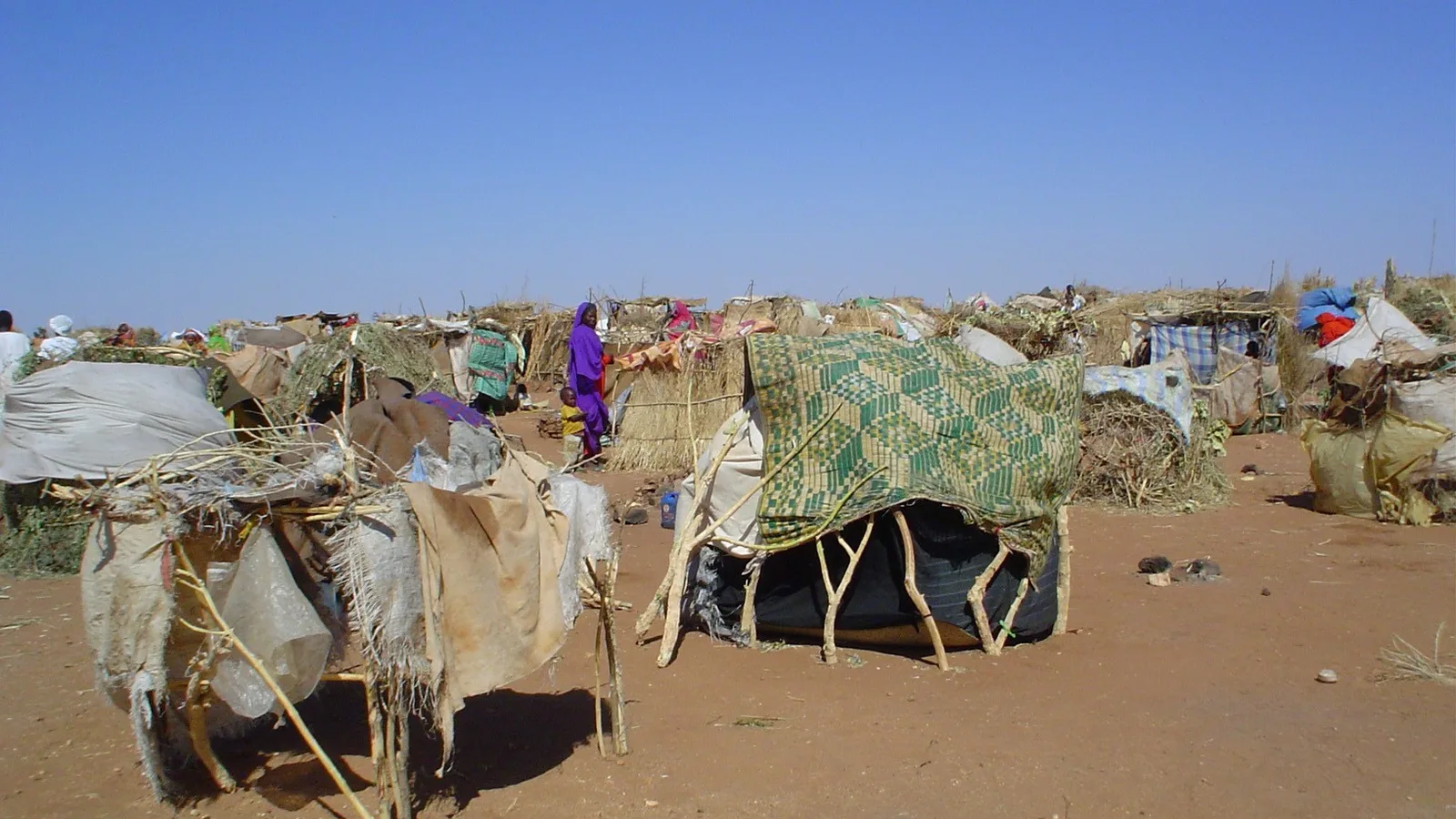
| People needing shelter | 15.4 million | UN News via allAfrica, 6 Nov 2026 |
| 2026 aid plan funded | 47% of $2.9 billion (20% in April) | UN News via allAfrica, 6 Nov 2026 |
Source: Listed in the table.
Aid agencies can help only about one in ten people in need, and the International Organization for Migration says its warehouses are "completely empty". Total deaths are uncertain. Estimates run from tens of thousands to as many as 400,000 (Kushkush, 2026).
Why the war stays out of the headlines
The neglect is not an accident. Four forces work together.
Reporters cannot get in. Foreign journalists have been denied visas at Port Sudan (Kushkush, 2026). The route from Chad into RSF territory is often too dangerous, and travelling with the army means the army controls what reporters see. Both sides refuse to give statements and reportedly monitor communications (Kostika, 2026), and internet and power cuts make sources hard to reach. The Sudanese Journalists Syndicate counts 32 journalists killed since 2023, while the Committee to Protect Journalists' count is lower, at 16. The syndicate also says 90 per cent of Sudan's media institutions have been damaged or destroyed.
Other crises take the space. The coverage study found that the disproportionate focus on a few conflicts "does not correlate with humanitarian severity or affected populations" (Dragomir & Marks, 2025). Journalist Isma'il Kushkush reports that coverage of Sudan dipped sharply in autumn 2023, after the 7 October attack on Israel (Kushkush, 2026). Media scholar Hussein AlAhmad describes "hierarchies of visibility" in which Sudan sits in a "liminal space" of news value.
The money for reporting is shrinking. The dismantling of the US Agency for Global Media ended funding for Bayn Nilein, a weekly Sudan programme on Alhurra, and Sudanese newsrooms are themselves short of money. Many journalists now work in exile, which makes it harder to verify what happens on the ground.
The story is told in a way that makes it hard to follow. Kurtz argues that "forgotten" is a misleading word (Kurtz, 2024). In his phrase, the limited attention has less to do with forgetfulness than, arguably, ignorance, and it is partly deliberate: the warring parties restrict the media, and donors have cut aid. Labelling the war "ethnic" or "tribal" can compound the problem, because it suggests ancient hatreds that outsiders cannot change. The UN evidence points the other way. It describes "a planned and organized operation" (Mishra, 2026) by armed groups, which governments can name and act on.
Coverage does exist, but it depends heavily on a few Sudanese reporters who, in the words of one Nieman Reports headline, risk everything to cover a war the world ignores.
What should change
- Pay for the reporting. News organisations and funders should pay Sudanese journalists, including those in exile, cover the cost of their security and connectivity, and credit them by name.
- Name the crimes precisely. Say who did what, using the UN findings, instead of "tribal clashes". Keep clear the line between what investigators have found and what courts have decided.
- Fully fund the aid plan. With only 47 per cent of the $2.9 billion plan received and agencies reaching about one in ten people in need, the shortfall is measured in lives.
- Enforce the arms embargo. The Fact-Finding Mission urged targeted sanctions and called on states with influence over the parties to respect arms embargoes and stop giving them material support.
- Act on warnings early. The mission found that no party took effective measures to protect civilians in El Fasher despite warnings from mid-2024. Fighting has now shifted to Kordofan, and that is where the next warnings should be heeded.
The world also has its own stake. Sudanese nationals are now among the largest nationalities arriving in Europe by the Eastern Mediterranean route (UN News, 2026). A war that is ignored does not stay where it started.