
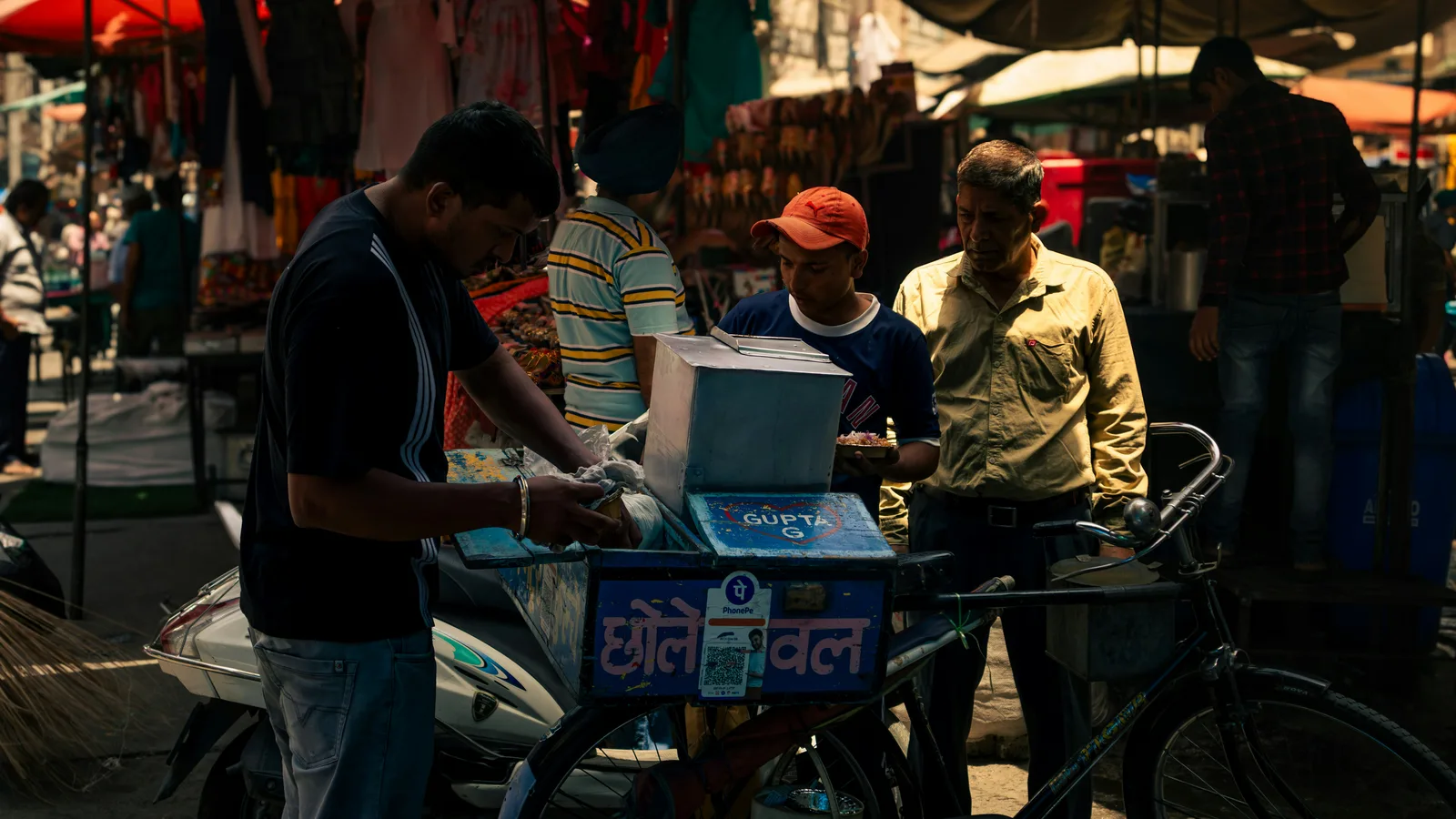

Ask an auto-rickshaw driver outside a metro station for a QR code, and you will learn something that no payments dashboard shows. Some drivers have no scanner. The same is true of the vegetable vendor down the lane and of the tea seller who deals in ten- and twenty-rupee notes. India is a global leader in digital payments, and a large part of its daily economy still runs on cash. The question, then, is not whether India can go cashless. Almost nobody serious is proposing to abolish cash overnight.
The better question is how much cash India still needs, and what happens to the people who rely on it when policy treats digital payments as the only modern way to pay. My argument is that UPI’s success does not mean everyone is ready to depend on it. Digital payments should keep expanding, but cash must stay easy to use while financial literacy, fraud protection, connectivity and trust catch up.
Pipes and people
The strongest case for a cashless India is UPI, the real-time payments system built by the National Payments Corporation of India (NPCI). It processed 24.07 billion transactions in September 2026, 23 per cent more than a year earlier.1 It is rightly admired abroad. But transaction volume measures infrastructure, not readiness. Infrastructure is the technology: UPI rails, bank networks, QR codes, and payment apps. Readiness is whether people can use these systems independently, confidently and safely.
Roads do not mean everyone can drive, and they do not mean everyone can afford a car. A count of transactions also treats every payment alike, so one person paying twenty times a day looks the same as twenty people paying once. Accounts tell a similar story. Jan Dhan, the government’s no-frills account scheme, had 59.04 crore accounts in August 2026, but 15.37 crore of them, about 26 per cent, were classified as inoperative, meaning no customer-initiated transactions for two years.2,3
An account opened is not the same as an account understood, or an account in use.
The same gap separates access from inclusion. An access-driven system assumes that once an option exists, people will adopt it. An inclusion-driven system does the extra work: language support, fraud education, dispute resolution and offline fallbacks. Much of UPI’s design effort goes into making the first payment easy. Far less visible is help with spotting a fake collect request, reversing an incorrect transfer, or recovering money lost to a scam. Too often the burden of adapting falls on the user.
Who still reaches for cash
Barriers differ from person to person, and it would be lazy to say that every older or rural user struggles. Plenty of grandparents use UPI without fuss. But some choose simple button phones because they are familiar and reliable, and for them cash means security, independence and control. A child in a small town handed fifteen rupees for the day will not be paid by transfer. And cash is cultural. The ₹2,100 given as shagun at a wedding, or the note pressed into a hand as a blessing, are gestures no payment app replicates.
Connectivity matters too. According to the digital rights group Access Now, there were 84 internet shutdowns in India in 2024 and 65 in 2025; in 2024, 12 were in Jammu and Kashmir and 21 in Manipur.4 Most were local and temporary, but when the network goes down, cash is the only payment that still works. Offline tools help. UPI Lite lets people pay up to ₹1,000 using a small balance stored on their phones.5
What of the cash figures themselves? Banknotes in circulation stood at roughly ₹35 lakh crore in March 2024, against about ₹18 lakh crore just before demonetisation in November 2016. That looks like cash growing while digital grew. But the economy grew too, and the currency’s share of GDP fell from about 12 per cent in 2016 to 11.7 per cent in 2024-25.6,7,8 Cash in circulation is also not the same as cash used for payments, since some of it is simply savings. The fair reading is narrower: digital payments have not replaced cash. They have grown alongside it.
Fraud and trust
Digital payments are instant and often hard to reverse, which raises the cost of every mistake. Today’s scams target ordinary people directly, through phishing links, fake payment requests and impersonation calls, and a single careless tap can empty an account. How big the problem is remains hard to say. Banks reported 293,239 cases of digital payment fraud worth ₹2,060.75 crore in 2023-24, but a change in reporting rules means later years cannot be compared with it.9
That is itself a finding: India has no consistent public measure of how often digital payments go wrong for ordinary users. The rules have lagged behind the scams. Under the RBI’s 2017 framework, a customer who reports a third-party breach within three working days owes nothing, and the bank carries the burden of proving the customer was at fault. But the framework was written for unauthorised transactions. My reading is that victims tricked into approving a payment themselves sat in a grey zone.10
The RBI has since moved. Amendment directions issued on 24 June 2026 widen the framework to fraudulent transactions generally, set limits on how long banks may take to resolve complaints and add compensation of up to ₹25,000 for losses of up to ₹50,000. They take effect only on 1 January 2027.11
Fear of fraud changes behaviour. Someone who was scammed once may go back to cash and stay there. A payment system works only when people trust it, and each other, and every unresolved scam erodes that trust.
Where policy fell short
The 2016 demonetisation aimed to curb black money. The RBI later reported that ₹15.31 lakh crore of the ₹15.42 lakh crore withdrawn, or 99.3 per cent, came back to the banking system.12 That shows the notes were not mostly sitting unreturned. It does not show that the ban achieved nothing: returned notes can include money laundered through deposits, and the ban had other stated aims, including digital adoption. What it does show is a plan that assumed people could change habits almost overnight.
Jan Dhan and Digital India put accounts and connectivity within reach of millions, and that is real progress. But the 15 crore inoperative accounts suggest that opening an account is easier than building the habit of using one. It is hard to judge from public data whether banks have invested enough in financial education, but the figures suggest a gap. UPI’s public rails now carry a market dominated by a few private apps: three accounted for 85.93 per cent of volume in August 2026.13
NPCI proposed a 30 per cent cap on any one app in 2020, and the deadline has been repeatedly pushed back, most recently to the end of 2026.14 Competition has brought convenience, and merchant payments of up to ₹2,000, which make up more than 95 per cent of UPI merchant (P2M) volume, still carry no merchant fee.15 Whether concentration leaves users worse protected, the data cannot say.
But apps are rewarded for growth in users and volume, and the new liability rules are issued to banks, which leaves accountability at the app level an open question. The common thread is a top-down approach: policy announced nationally, uniform expectations, and quick adaptation. A ground-up approach would phase adoption in, run pilots in rural and semi-urban areas, train people locally and build fallbacks for system failures.
Conclusion
India’s digital payments revolution is a genuine achievement, and it should continue to expand. But its success should not be measured by how quickly cash disappears. It should be measured by how confidently and safely people can take part in the economy.
That means stronger fraud protection and faster grievance redressal, financial education through trusted local institutions, offline options for those who cannot rely on the network, and measures of inclusion that go beyond transaction counts, while cash remains easy to access and accept. The next time an auto-rickshaw driver shrugs at your phone, remember that the shrug is data too. The real measure of a modern economy is not how little cash it uses, but how few people it leaves behind.
Until readiness catches up with infrastructure, cash is not a weakness of the Indian economy. It is its safety net.