

Introduction
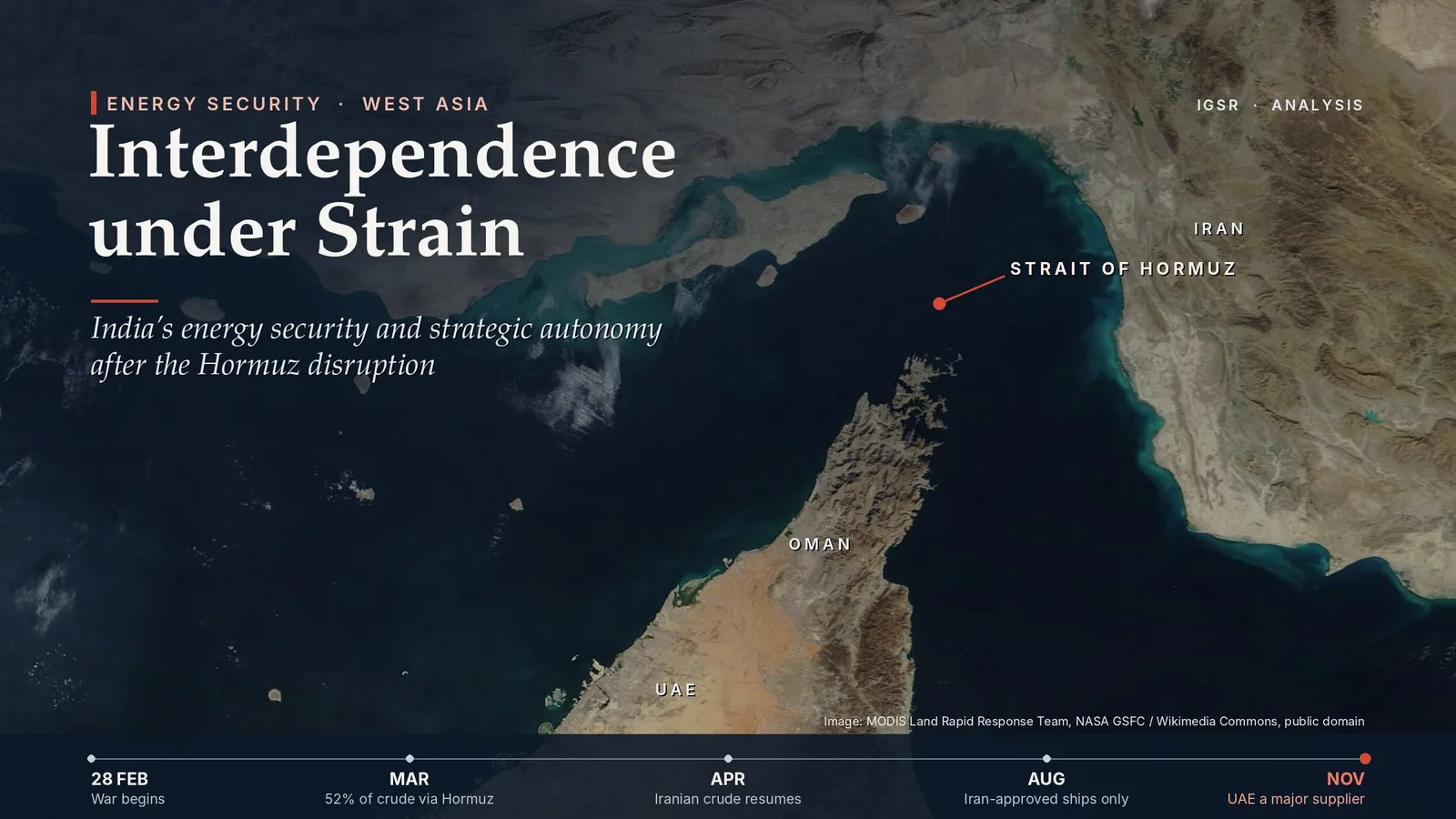
On 28 February 2026, war between Iran and a coalition of the United States and Israel began, and shipping through the Strait of Hormuz was effectively halted (The National, 2026). In peacetime, roughly one-fifth of the world’s oil and liquefied natural gas (LNG) passes through the strait (Al Jazeera, 2026). By mid-August, Iranian forces were letting through only vessels they had approved, and US–Iran talks had stalled (Al Jazeera, 2026). In early November, oil prices were still described as elevated (The National, 2026).
India is directly exposed. It is the world’s third-largest oil importer and depends heavily on supplies that transit the strait (CNBC, 2026b). Ordinary households and businesses feel the disruption through fuel prices and the import bill.
This article asks three questions. How exposed was India’s energy system to the disruption? How did it adjust? And what do those adjustments say about how much room India has for independent action, which Indian foreign policy calls strategic autonomy? The analysis draws on public reporting, ministry statements as relayed by the press, and commercial tracking data. Several figures are estimates from commercial sources, and events are still unfolding, so the numbers are indicative, not final.
Analytical framework
Keohane and Nye (2012) separate two ways in which states depend on one another. Sensitivity is how quickly a change in one place imposes costs elsewhere, before any policy response. Vulnerability is how costly it remains to adjust once the change has happened, and it depends on the alternatives available. Two importers can be equally sensitive to a price spike and still differ in vulnerability, if one holds large stocks and many suppliers and the other does not.
Yergin (2006) gives the energy version. For him, energy security rests on diversified supply, resilience in the form of spare capacity and stockpiles, and integration with global markets. Put together, the two approaches give a simple test for this case. India’s sensitivity shows in its exposure to Hormuz flows; its vulnerability shows in how many supply options it has and how large its buffers are.
India’s exposure before and during the disruption
S&P Global (2026b) put the share of India’s crude imports transiting Hormuz at around 52% in early March 2026, against 41% in 2025, on total imports of roughly 5 million barrels per day. The rise came as Indian refiners cut Russian purchases, which averaged about 1.15 million barrels per day in the first two months of 2026 compared with 1.7 million in 2025 (S&P Global, 2026b). Reporting links this shift to India’s effort to secure a trade deal with Washington, which led it to reduce Russian oil and buy more from the Middle East (CNBC, 2026b). The point matters for the argument: a decision taken in trade policy raised India’s energy exposure shortly before the strait closed.
Dependence on the strait is not unique to India. According to the U.S. Energy Information Administration (EIA, 2025), about 20.1 million barrels per day of crude, condensate and oil products moved through it in the first quarter of 2025, and China, India, Japan and South Korea were the main Asian destinations for crude. Estimates of India’s own share vary with the period and the measure used, which is why the 41% and 52% figures above differ.
Buffers were thin relative to the shock. Petroleum ministry data cited by S&P Global (2026b) showed strategic reserves equal to about 9.5 days of net imports, and total storage, including tanks held by state-run companies, equal to about 74 days. That is enough for a short interruption, not a prolonged one.
Adjustment under pressure
India responded on several fronts at once (Table 1). In early April, the petroleum ministry said refiners had secured crude from more than 40 countries, including Iran (CNBC, 2026b). Iranian purchases resumed for the first time since 2019 after a US waiver, and an official said India expected Iran’s cooperation in ensuring safe passage for its ships (CNBC, 2026b). Russian crude purchases rose too. Kpler data reported by CNBC (2026a) showed Russia’s share of India’s imports nearly doubling from about 20% in February, even as total imports fell by more than 14% from pre-war levels. By November, the United Arab Emirates was reported to be emerging as a major supplier, with cooperation extending to crude storage and gas supply (The National, 2026).
Table 1. India’s main responses to the Hormuz disruption, 2026
| Response | What was reported | Qualification |
|---|---|---|
| Iranian crude | First purchases since 2019, after a US waiver (CNBC, 2026b). | Depends on the waiver; hurdles to buying remained (S&P Global, 2026a). |
| Gulf supplier (UAE) | Reported as an emerging major supplier, with cooperation on storage and gas (The National, 2026). | Oil prices remained elevated (The National, 2026). |
| Strategic reserves | About 9.5 days of net imports; about 74 days including state-run storage (S&P Global, 2026b). | Cover measured in days, not months. |
Source: Author’s compilation based on CNBC (2026a, 2026b), S&P Global (2026a, 2026b) and The National (2026)
Each response in Table 1 came with a qualification. Wider sourcing did not restore pre-war volumes. Russian crude was available, but India and China were reported to be competing for the same scarce cargoes (CNBC, 2026a). Iranian crude depended on a waiver, and hurdles to buying it remained (S&P Global, 2026a). Reserves were measured in days, and procurement costs rose sharply (CNBC, 2026b).
Strategic autonomy tested
Indian foreign policy has long favoured keeping options open instead of aligning with a single bloc, a posture usually called strategic autonomy. The 2026 episode shows what that posture delivers in a supply emergency.
The evidence can be read two ways. On the first, India showed flexibility: it kept supply lines open with parties on opposing sides of the conflict, buying from Iran, Russia and Gulf producers within the same few months. On the second, India showed dependence. Each alternative rested on a decision outside its control: a US waiver for Iranian oil, Russian willingness to sell into a tight market, and Iranian approval for ships to pass the strait. Seen this way, flexibility without control over the underlying conditions is closer to skilful improvisation than to autonomy.
The data reviewed here do not rule out either reading. They differ over what counts as autonomy: the ability to choose among partners, or the ability to withstand the loss of any one of them. The vulnerability framework favours the second test, since it measures the cost of adjusting, not the number of options on paper.
Implications for policy
Four implications follow from the evidence, and none of them depends on a political position. First, if vulnerability depends on adjustment capacity, buffers matter as much as diplomacy. Analysts at S&P Global Energy argued in June that India cannot treat energy security as a procurement problem alone and needs larger inventories and more flexible supply options (Asian News International, 2026). Second, the earlier shift away from Russian crude shows that sourcing choices made for trade or diplomatic reasons should be checked for their effect on chokepoint exposure.
Third, Iran and Oman are negotiating the management of the strait (Al Jazeera, 2026), and India is not reported as a party to those talks. Its influence over the outcome is therefore likely to be indirect, exercised through its relations with the states involved. Fourth, exposure is not limited to crude. The strait also carries a large share of global LNG (Al Jazeera, 2026), which matters for industrial gas users and fertiliser production, so contingency planning should cover gas as well as oil.
Conclusion
The 2026 Hormuz disruption showed that India’s sensitivity to a single chokepoint was high, and rising, just before the shock. Wider sourcing and external waivers reduced its vulnerability but did not remove it. India kept buying from many suppliers, though at lower volumes and higher cost, and the adjustments relied on conditions that others controlled.
For the study of Indian foreign policy, the case suggests that autonomy in energy is better judged by the capacity to absorb loss than by the number of partners. Future research should revisit these findings once the strait’s status is settled and official 2026 trade data are available.