

Over the past decade, the global energy sector has shifted away from fossil fuels toward solar, wind, hydrogen and other renewables. Oil-exporting economies are the most exposed to this change. In 2024, the Middle East produced about 30% of the world’s oil and held 79.4% of MENA’s oil reserves (IEA, 2025). Across the region, fossil fuel rents generate up to 14.3% of GDP, 61.2% of exports and 38.6% of government revenue (Jensen, 2024). This structural dependence, often described as “Dutch disease,” makes diversification difficult (Karanfil & Omgba, 2023). Pressure to change is growing on two fronts. Internally, oil exporters could lose up to 60% of their oil rents, or 120–142% of GDP (Jensen, 2024). The 2015 oil price collapse and the COVID-19 pandemic showed how exposed these economies are to price shocks (Asiri et al., 2022). Externally, major Asian importers have committed to carbon neutrality, which threatens future demand for Gulf exports (Abdallah et al., 2024). Gulf states have responded with national development plans, investment in renewables and hydrogen, and fiscal reforms such as subsidy removal and the use of sovereign wealth funds (Abdallah et al., 2024; Lashitew et al., 2021). Results vary, however. Success depends on a country’s institutions, financial reserves and starting level of diversification (Jensen, 2024; Lashitew et al., 2021). Saudi Arabia is a critical case. It is the region’s largest oil producer, and through Vision 2030, it has launched one of the most ambitious transition programs among oil-dependent economies. Some argue that the Kingdom is reinvesting its oil revenues in ways that challenge the idea of fossil-fuel lock-in (Zehri, 2025). Others warn that oil-dependent countries still struggle to balance growth with sustainable energy development (Heidary et al., 2025). This article analyzes the economic impact of the energy transition in Saudi Arabia, focusing on its fiscal, structural and macroeconomic risks. It asks whether the Kingdom’s strategy is a genuine move beyond the resource curse, or whether oil revenue volatility, high transition costs and reliance on carbon offsets may limit long-term diversification and growth.
Saudi Arabia: A critical case for the energy transition
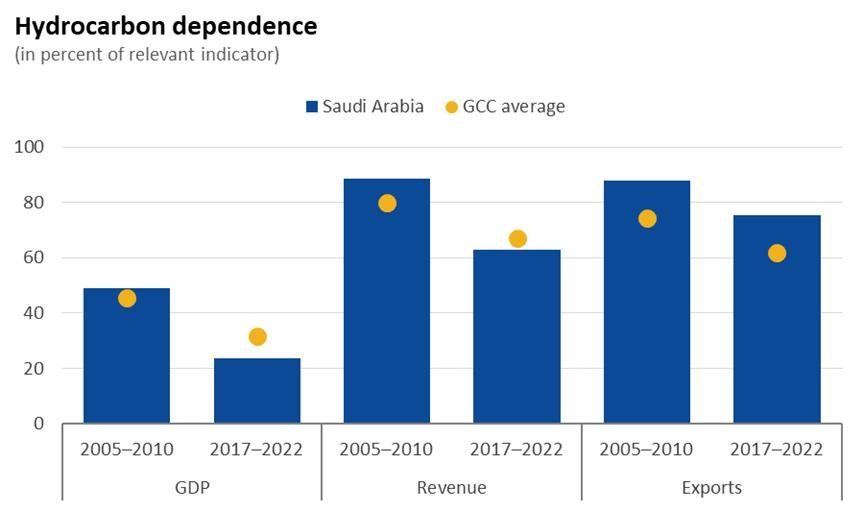
For years, the “resource curse” has suggested that oil-rich countries struggle to combine strong growth with sustainable energy development (Heidary et al., 2025). Saudi Arabia may be starting to break that pattern. The Kingdom maintains its regional dominance. It ranks first in the region for both total oil supply (42%) and crude oil production (39%) (IEA, 2025). Its economic structure, however, is undergoing significant change. According to the IMF (2025), the Saudi economy has shown notable resilience to external shocks, supported by rapid growth in non-oil activity, stable inflation and low unemployment. Simultaneously, the energy transition is rapidly expanding. UNDP advisers Jeffrey Beyer and Stephen Gitonga note that Saudi Arabia is deploying solar energy faster than any country in history (Beyer & Gitonga, 2025). As Figure 1 shows, oil’s share of GDP fell by about 25 percentage points, its share of government revenue by 27 points and its share of exports by 12 points (Mati & Rehman, 2023). The Kingdom is clearly growing industries beyond oil.
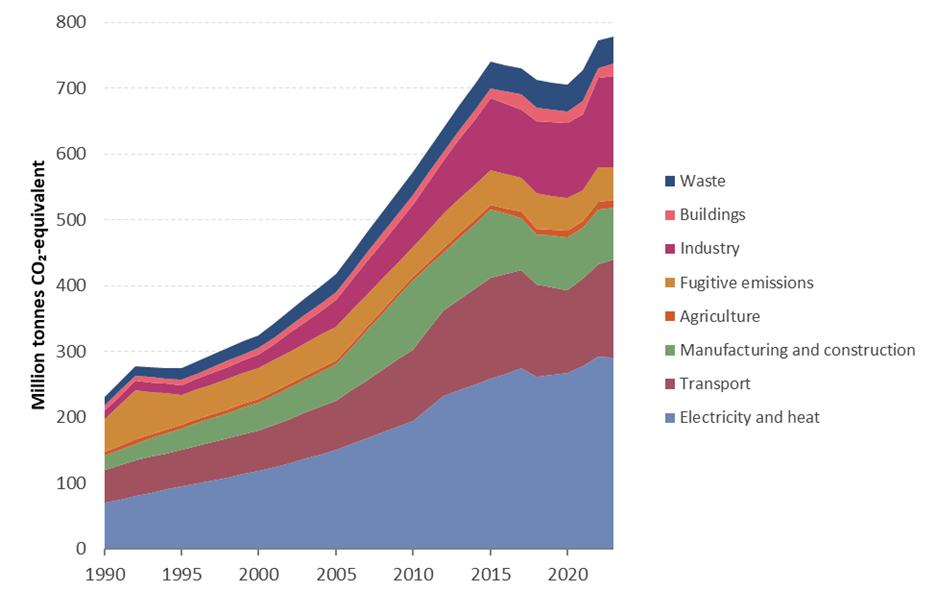
The steady rise in emissions reflects the intensive infrastructure and industrial expansion that diversification requires. In major energy-producing economies, emissions remain concentrated in power generation and petrochemicals. Research shows that positive shocks in non-renewable energy supply raise industrial output in Saudi Arabia (Alsulamy et al., 2025), which helps explain why emissions continue to grow as the Kingdom expands its manufacturing base. In other words, diversification remains fueled by oil. This points to a deeper tension at the heart of Vision 2030. Saudi Arabia is using oil revenue to build an economy that depends less on oil. That strategy is the plan’s central bet, and potentially its greatest vulnerability.
Strategic decarbonization initiatives
To close this gap, Saudi Arabia has launched a set of large-scale projects to grow the economy and cut emissions. Central to these efforts is Vision 2030, launched in 2016, which sets out an “optimal energy mix” for the power sector. The target is a grid supplied equally by natural gas and renewable energy by 2030, ending the use of liquid crude for electricity generation. That matters because every barrel of oil no longer consumed domestically becomes available for export. Electricity is where the shift is most visible. Solar and wind plants such as Sudair, Al-Shuaibah and Dumat Al Jandal are leading that shift. The Kingdom also wants to export clean energy, not just use it domestically. The flagship is the NEOM green hydrogen project, a multi-billion-dollar plant powered entirely by renewables that will produce green ammonia for export (Zehri, 2025). Alongside it, the Jubail carbon capture hub aims to cut emissions from existing oil and petrochemical operations. Finally, Saudi Arabia is counting on nature to absorb what it cannot yet cut. The Saudi Green Initiative plans to plant 10 billion trees and restore mangroves at home, and the Middle East Green Initiative aims to plant 40 billion trees across the region.
The price of ambition
These ambitions carry a substantial cost. Saudi Arabia has pledged about $270 billion for low-carbon projects by 2030, a sum comparable to its annual fiscal budget, including $30–50 billion for renewables alone (Islam & Ali, 2024). Solar and wind also require grid reinforcement, large-scale storage and smart-grid technologies. Under deregulated fuel prices, these could more than double the cost of delivering electricity, from $72.6 to over $156 per MWh (Islam & Ali, 2024). The scale of these commitments has forced difficult trade-offs, and The Line illustrates them clearly. Originally conceived as a 170-kilometre linear city housing millions of residents, the project’s cost rose from $500 billion to between $1 trillion and $8.8 trillion. Approximately $50 billion had been spent on NEOM by early 2026. Plans were reduced to just 2.4 kilometres, construction was suspended, and in March 2026 major contracts for the project were terminated. The lesson is clear: the energy transition is as much a budget exercise as an environmental one. Even the most well-resourced states must decide carefully which projects to prioritize.
Financing the exit with oil
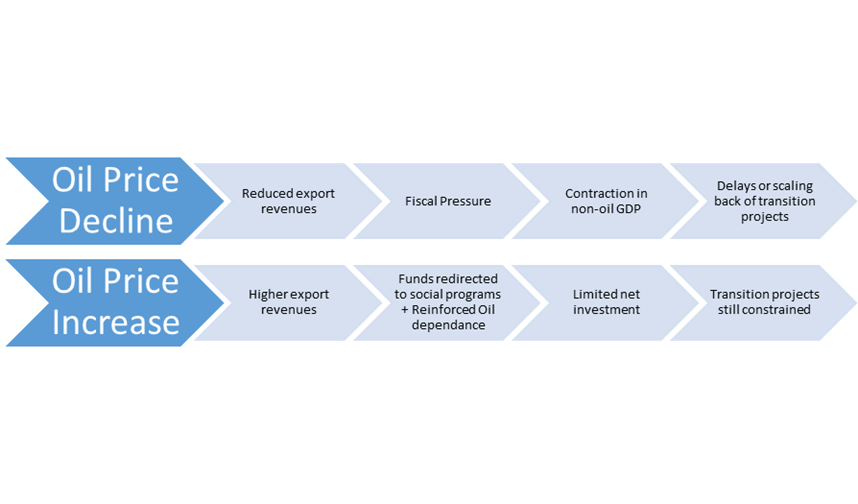
The timing of the transition poses a second, less visible risk. Expanding new sectors before oil dependence has dramatically declined can leave an economy more vulnerable to demand shocks, price volatility and fiscal imbalances (Karanfil & Omgba, 2023). Because Saudi Arabia’s budget remains closely tied to hydrocarbon revenue, the sequencing of its reforms is critical. Energy subsidy reform shows this tension clearly. The cuts freed approximately $40 billion in 2019. Rather than being kept as a fiscal buffer, however, most of these savings were channeled into renewable investment and about $26 billion in Citizen Account payouts (Al-Saidi, 2022). Oil price movements also spread well beyond the energy sector: a 10% change in global oil prices is associated with a 0.5% change in non-oil GDP (PwC, 2025). Periods of high prices offer less relief than might be expected, as windfalls tend to be absorbed by social spending rather than invested in new industries (Al-Saidi, 2022).
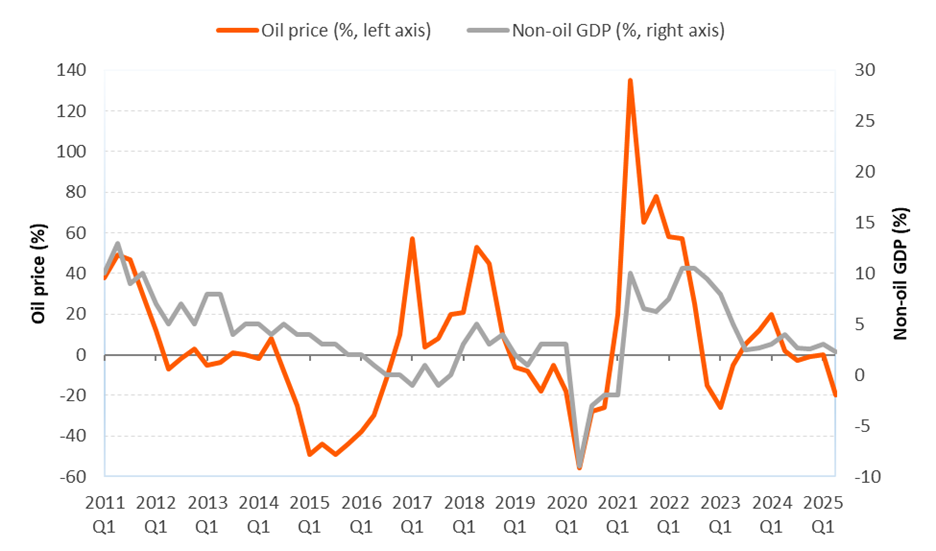
As Figure 4 illustrates, the result is a central paradox. Saudi Arabia must rely on oil revenue to finance its transition away from oil. As oil prices decline, the need for economic diversification becomes more pressing, while the financial resources available to support it become increasingly constrained.
The hidden cost of carbon offsets
A further risk lies in the Kingdom’s growing reliance on carbon credits. Major national companies, including Aramco, SABIC, ACWA Power and the Saudi Electricity Company, expect offsets to account for a significant share of their emission reductions (Zakkour et al., 2025). Offsets allow firms to meet climate targets without changing how they produce, which may delay the structural change that real diversification requires. They also expose the economy to forces beyond its control. Voluntary carbon markets face growing scrutiny, and if Saudi firms rely on credits later judged to be of low quality, their exports could face carbon border taxes abroad (Zakkour et al., 2025). The opportunity cost is just as significant. If petrochemical firms use offsets for up to 20% of their mitigation, they risk creating an “innovation gap”: capital flows into reductions that exist largely on paper instead of technologies such as green hydrogen that would keep them competitive in a post-oil economy (Zakkour et al., 2025). The deeper danger is lock-in, with resources spent on preserving the status quo rather than on securing a place in the global green economy.
Conclusion: Can oil pay for a future without it?
Saudi Arabia’s energy transition is one of the most ambitious economic restructuring efforts ever attempted by an oil-dependent economy. The Kingdom has made real progress, with a shrinking oil share of GDP, record solar deployment and a growing non-oil sector. Yet the transition remains constrained by the very dependence it seeks to escape. High upfront costs, exposure to oil price swings and a growing reliance on carbon offsets show how difficult the trade-offs facing policymakers are. The broader lesson is that, for resource-rich economies, the energy transition is not simply a technological shift. It is a careful balancing act between fiscal stability, economic diversification and environmental goals. Success will depend on sequencing: reducing oil dependence and building competitive non-oil industries in step with each other, so that the Kingdom avoids relying on hydrocarbons to finance a post-hydrocarbon future. Several questions remain open. Saudi Arabia might gain more from Hirschman’s approach of prioritizing immediate, high-impact investments than from concentrating on long-term megaprojects. The scaling back of The Line may signal a deliberate shift toward AI and technology projects that promise faster returns. And considering recent geopolitical tensions, investments such as the Red Sea pipelines may offer a lower opportunity cost than current projects. How the Kingdom answers these questions will show whether it can balance short-term stability with long-term transformation.