
Introduction
Who gets to make decisions in global politics, and who gets to define the problems those decisions are meant to address? The two questions are related, but they do not always have the same answer. International institutions distribute authority through membership rules, voting procedures and mandates. They also shape political debate by deciding which issues receive attention, how crises are described and what counts as a legitimate response. These processes are especially visible when the United Nations Security Council (UNSC) is compared with the Group of Twenty (G20).
The UNSC is a Charter-based body with primary responsibility for international peace and security. Its five permanent members hold veto power over substantive decisions. The G20, by contrast, is an informal forum whose influence rests on the economic weight of its members, negotiation and coordination rather than equivalent binding legal authority. This article argues that institutional power determines access to authoritative decision-making, while narrative power shapes the interpretation of global problems and the legitimacy of proposed responses. Neither form alone guarantees effective influence: outcomes also depend on material capabilities, political cooperation and implementation.
Power beyond formal authority
Barnett and Duvall (2005) show that power in international politics operates through more than direct coercion. Their framework draws attention to institutional arrangements that structure actors' opportunities, as well as productive forms of power that shape identities, categories and accepted meanings. This distinction helps explain why a state's influence cannot be measured only by whether it holds a formal vote or veto.
Antonio Gramsci's account of hegemony highlights how durable leadership depends partly on consent and the presentation of particular interests as broadly acceptable (Gramsci, 1971). Robert W. Cox (1981) similarly argues that international institutions should be understood within the historical and material structures in which they emerge. These approaches invite scrutiny of whose interests institutional rules privilege and how those arrangements are justified.
Michel Foucault's work on power and knowledge adds a focus on discourse: the language and categories through which problems become intelligible and governable (Foucault, 1980). Calling an issue a security threat, a debt crisis or a development challenge can influence which actors are heard and which policy tools appear appropriate. Narrative power is therefore not simply persuasive communication. It is the capacity to frame issues, establish priorities and influence the standards by which authority is judged. It overlaps with Joseph Nye's concept of soft power, but is not identical to it: narratives may shape debate even when they do not generate attraction or agreement (Nye, 2004).
The UN Security Council: authority and the veto
The UNSC's authority is grounded in the UN Charter. Article 24 assigns it primary responsibility for maintaining international peace and security, while Article 25 requires UN members to accept and carry out its decisions in accordance with the Charter. Under Article 27, substantive decisions require at least nine affirmative votes and are subject to the concurring-vote arrangement for the permanent members; a negative vote by a permanent member prevents adoption (United Nations, 1945; United Nations Dag Hammarskjöld Library, n.d.).
The veto institutionalises an unequal distribution of decision-making power. The arrangement reflects the political settlement that accompanied the creation of the United Nations in 1945, when the major powers were given a privileged role in the new security order. A Coxian reading draws attention to the way this historical settlement remains embedded in contemporary institutional practice. The Council's authority is not merely procedural: its decisions can carry significant legal and political consequences.
Yet formal authority does not ensure collective action. A permanent member's veto can block a draft resolution even where other Council members support it. The UN's published veto record, for example, lists a Russian veto on 24 February 2025 concerning the maintenance of peace and security of Ukraine, and United States vetoes on draft resolutions concerning the situation in the Middle East in 2025 (United Nations Dag Hammarskjöld Library, n.d.). Such cases illustrate how disagreement among permanent members can constrain the Council's ability to respond.
Legitimacy is also contested. The permanent membership reflects the geopolitical circumstances of 1945 rather than the contemporary distribution of population, regional representation or economic influence. The General Assembly's intergovernmental negotiations on Security Council reform continued into its eightieth session, demonstrating that questions of equitable representation and membership expansion remain unresolved (United Nations General Assembly, n.d.). The Council thus combines substantial formal authority with persistent disputes about representativeness and effectiveness.
The G20: agenda-setting without equivalent legal authority
The G20 offers a different route to influence. It emerged in 1999 and was elevated to the leaders' level in 2008. Its members account for a major share of global economic activity, giving the forum considerable convening power. However, it is not a treaty-based organisation with a Charter equivalent to that of the United Nations, and its declarations generally rely on political commitment and implementation by national governments.
This informality does not make the G20 powerless. Its discussions can coordinate expectations among major economies, signal policy priorities and shape the agendas of other institutions. Keohane's account of cooperation under conditions of interdependence helps explain why institutions and recurring negotiations can facilitate coordination even without a central authority capable of enforcing every commitment (Keohane, 1984). At the same time, economic weight affects whose preferences carry influence within the forum.
The G20 must also establish why its decisions and priorities deserve wider acceptance. Its language of inclusive growth, sustainable development and cooperation is part of that legitimacy claim. A critical perspective asks whether these narratives are matched by representation and implementation, or whether the language of inclusion can coexist with unequal influence among participants.
India's presidency and the politics of inclusion
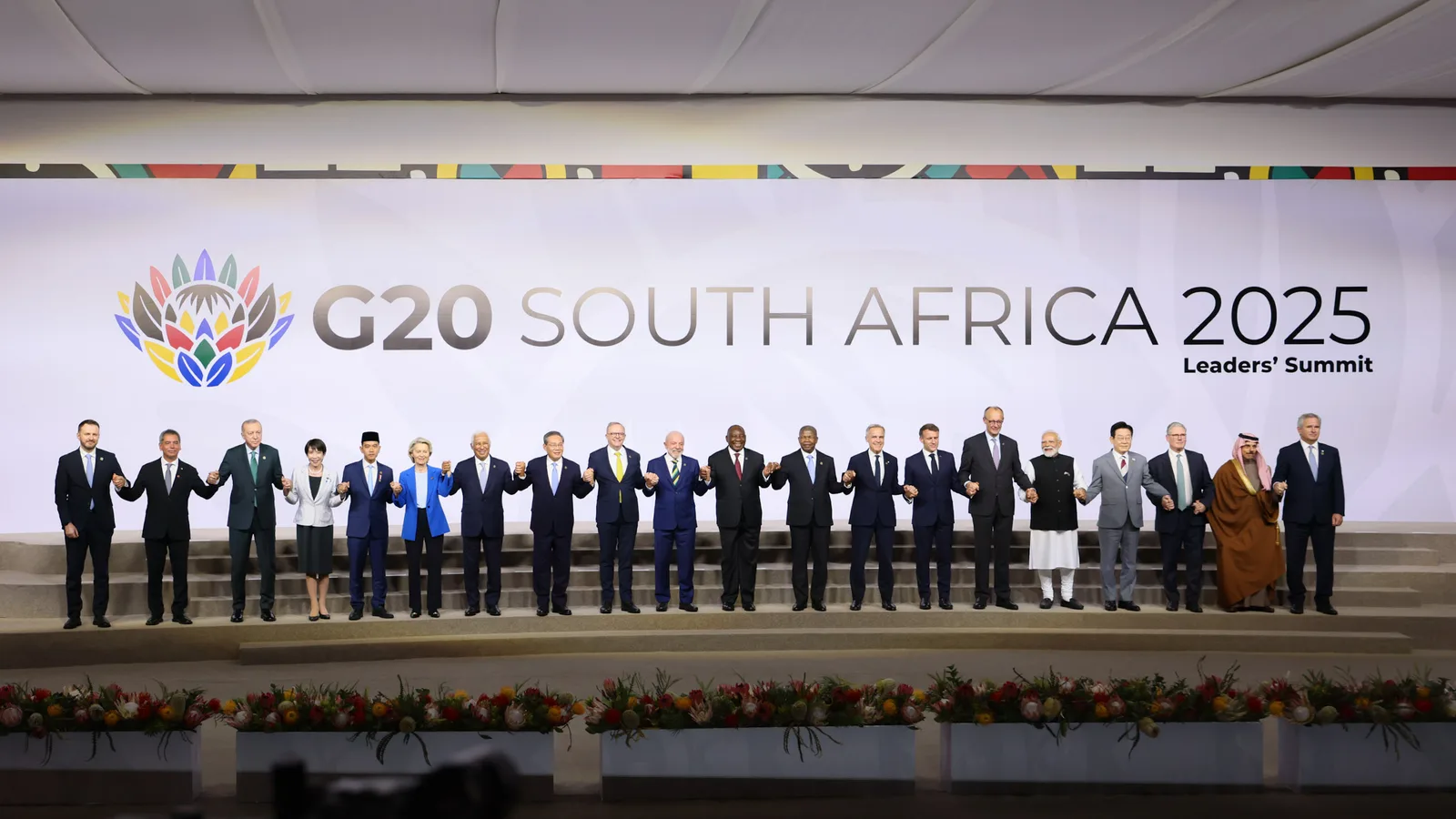
India's 2023 G20 presidency offers a concrete example of agenda-setting as a form of influence. Under the theme 'One Earth, One Family, One Future', India placed emphasis on sustainable development and the concerns of developing countries. The New Delhi Leaders' Declaration was adopted by consensus, and it welcomed the African Union as a permanent member of the G20 (United Nations in India, 2023).
The African Union's admission matters because it altered the forum's membership and gave a continental organisation a permanent seat at the table. India's Ministry of External Affairs described amplifying the voice and representation of the Global South as a priority of its presidency, while the Voice of Global South Summit provided a platform for partner countries to discuss shared concerns (Ministry of External Affairs, Government of India, 2023). These developments show how a presidency can use convening power, coalition-building and political framing to influence an institution's agenda.
The example should not, however, be overstated. The African Union's admission was a tangible membership change, but it did not make the G20 universally representative or eliminate differences in economic and diplomatic capacity among members. Nor did India's presidency alter the UNSC's permanent-member structure. Narrative influence can help build support for reform and shift priorities; it does not by itself transfer veto rights or guarantee implementation.
What the comparison reveals
The UNSC and G20 illustrate different combinations of institutional and narrative power. The Security Council has a stronger formal mandate and more consequential decision-making procedures, but its capacity to act can be limited by veto politics and legitimacy disputes. The G20 has less formal authority but can exercise influence through economic coordination, agenda-setting and the ability to assemble major economies around shared language and commitments.
The distinction is not absolute. The UNSC also uses narratives of collective security and international responsibility to justify its role; the G20 also contains institutional rules and patterns of unequal influence. Both institutions therefore combine formal arrangements with political meaning. Gramsci helps explain how consent supports institutional leadership, while Foucault draws attention to how the framing of issues shapes the boundaries of debate. Barnett and Duvall's framework brings these insights together by showing that power operates through rules and through the production of accepted categories.
For states seeking a greater role in global governance, the implication is that participation in existing forums matters, but so does the ability to build coalitions and articulate credible alternatives. However, claims to represent the Global South must be assessed against actual consultation, representation and outcomes rather than accepted solely on the basis of diplomatic language.
Conclusion
Global governance cannot be understood by examining formal authority alone. The UNSC demonstrates how institutional rules can concentrate decision-making power, while the G20 shows how economic weight, negotiation and agenda-setting can generate influence without equivalent binding authority. India's G20 presidency and the African Union's admission illustrate that narrative and diplomatic power can contribute to institutional change, although they cannot independently overcome entrenched structures elsewhere.
Institutional power shapes who can make authoritative decisions; narrative power shapes how problems, priorities and authority are understood. Their interaction affects legitimacy and the prospects for cooperation. A more representative and effective system of global governance therefore requires attention not only to who holds formal privileges, but also to whose concerns shape the international agenda and whether commitments produce measurable action.